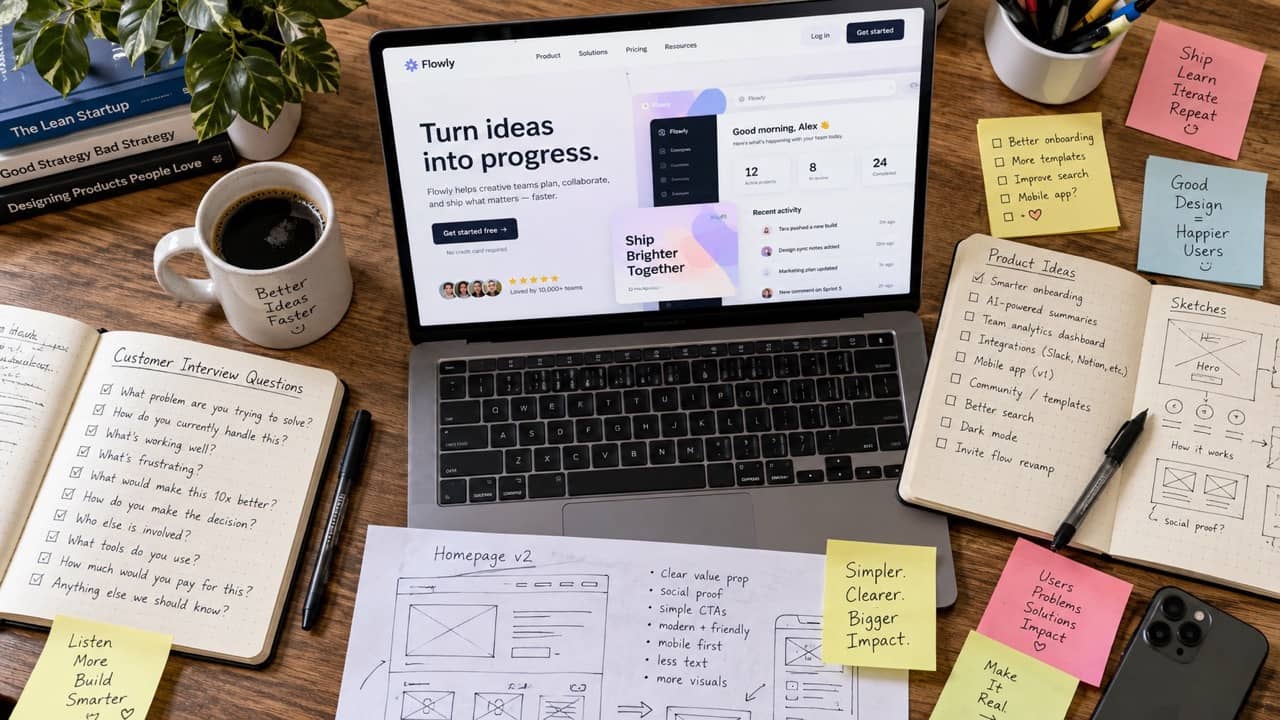
A small business owner can now describe a website to an AI assistant and watch something surprisingly polished appear in minutes.
The copy can sound professional. The layout can look clean. The code may even work. AI can suggest search keywords, write FAQs, generate images, create forms, recommend calls to action, and help connect all of it together.
I think that’s exciting.
I use AI regularly in my own work. It helps me research, troubleshoot technical problems, explore ideas, write and review code, organize information, and get from a rough idea to something testable much faster.
But the better these tools get, the more I keep thinking about a lesson I learned long before ChatGPT existed:
Building something is not the same as understanding what should be built.
That distinction is becoming much more important.
A lesson I learned at Lean Startup Machine
Years ago, I attended Lean Startup Machine in Chicago. My team was working on an idea called Impulse Coupons, a mobile app that would send relevant coupons to people based on their location.
Like most new ideas, ours came with a pile of assumptions.
- We believed college students would act on location-based coupons.
- We believed local bars and restaurants might pay a monthly fee to participate.
- We believed businesses needed a better way to track coupon redemption.
The important part of the weekend wasn’t sitting in a room debating whether those ideas sounded good.
We had to test them.
We interviewed potential customers. We talked with businesses. We designed experiments. Some of them worked. Some of them didn’t.
One of our early assumptions was that college students simply needed coupons delivered to them at the right place and time. But talking with students showed us that discovery itself was a bigger problem than we had expected.
Another experiment failed because we hadn’t designed the test carefully enough. Instead of proving our idea right or wrong, it taught us that the experiment itself needed to be better.
We also learned that businesses we interviewed didn’t necessarily want the pricing model we had imagined. Some preferred paying per message rather than a flat monthly fee.
That was the point.
Our assumptions were supposed to be challenged.

The prototype wasn’t really the learning.
The process was the learning.
Then AI changed the speed of everything
That experience came back to me while reading a recent article by entrepreneur and educator Steve Blank about what happened in his 2026 Lean LaunchPad class.
For years, students in his classes would begin with hypotheses, talk with customers, test assumptions, and gradually develop a minimum viable product based on what they learned.
In his Spring 2026 class, something changed.
Students could create remarkably complete products almost immediately with AI. At first, that looked like extraordinary progress. But Blank and his teaching team noticed a problem.
The students had gotten much better at producing things, but some were learning less about the people and problems those products were supposed to serve.
Instead of using a prototype to test an assumption, the finished-looking product could make the original idea feel more validated than it really was.
Blank called this “evidence theater.” A polished result looked like progress even when the underlying assumptions had barely been tested.
He also used another phrase that caught my attention: learning debt.
You can arrive at an impressive answer without fully understanding how you got there. Eventually, that debt comes due.
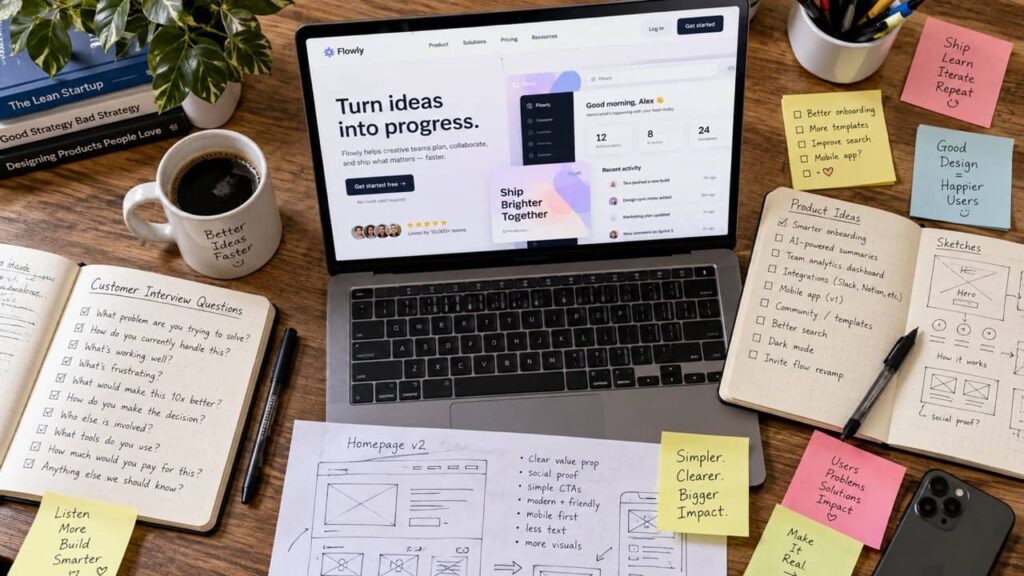
A finished-looking website may not mean very much anymore
For most of the history of the web, creating a polished website required a meaningful amount of time, technical knowledge, and money.
That created a natural bottleneck. You couldn’t easily jump straight from an idea to something that looked complete.
AI is removing much of that bottleneck.
Today, a business can generate a surprisingly sophisticated website before answering some very basic questions.
- Who is this website actually for?
- What are those people trying to accomplish?
- What questions do customers really ask?
- Which services matter most?
- What makes this organization different?
- What evidence builds trust?
- What should someone do next?
Those questions aren’t technical.
They’re judgment questions.
And AI can make it very easy to skip over them.
An AI-generated homepage might look beautiful while never clearly explaining what the company does or who it serves.
An AI SEO tool might generate dozens of service-area pages and hundreds of FAQs. Everything could be formatted correctly while answering questions nobody is actually asking.
An AI coding assistant might build a customer portal that appears to work perfectly while nobody has carefully reviewed its security, privacy, accessibility, or long-term maintenance.
None of these problems started with AI.
We had confusing websites, bad SEO, inaccessible design, insecure code, and questionable marketing long before generative AI arrived.
AI simply allows us to produce the consequences of a bad assumption much faster.

The bottleneck has moved
One of Blank’s conclusions is that the bottleneck for startups is shifting away from the cost and difficulty of building a product.
Instead, the harder problem becomes deciding what to build and who to build it for.
I think the same thing is happening in digital marketing and web development.
When almost anyone can generate copy, code, layouts, images, and marketing ideas, those things become less scarce.
Other things become more valuable:
Judgment. Context. Curiosity. Verification. Responsibility.
A website project increasingly needs someone asking questions like:
- Does this reflect what customers actually need?
- Is this information accurate?
- Does this work for people with disabilities?
- Are we solving a real problem or simply adding another feature?
- Does this technology make sense for this organization?
- Is this something we can maintain?
- Who understands how it works?
- Who is responsible for it after it launches?
Those questions aren’t important because AI can’t help answer them. AI can help with many of them.
They’re important because someone still has to decide whether the answer makes sense.
AI belongs in the process
I don’t think the answer is to avoid AI.
Quite the opposite.
I think these tools are going to become a normal part of how many of us work.
AI can help us prototype ideas faster. It can help analyze data. It can identify questions we haven’t considered. It can summarize research, explore alternatives, write code, troubleshoot problems, and handle repetitive work.
Used well, AI can give small organizations capabilities that would have been difficult or expensive to access only a few years ago.
That’s a good thing.
My concern isn’t that AI will prevent us from producing good work.
I think we’re heading toward a world where we’ll be able to produce more than we ever imagined.
What I worry about is whether we’ll continue exercising the curiosity, skepticism, and judgment that help us decide what deserves to be produced in the first place.
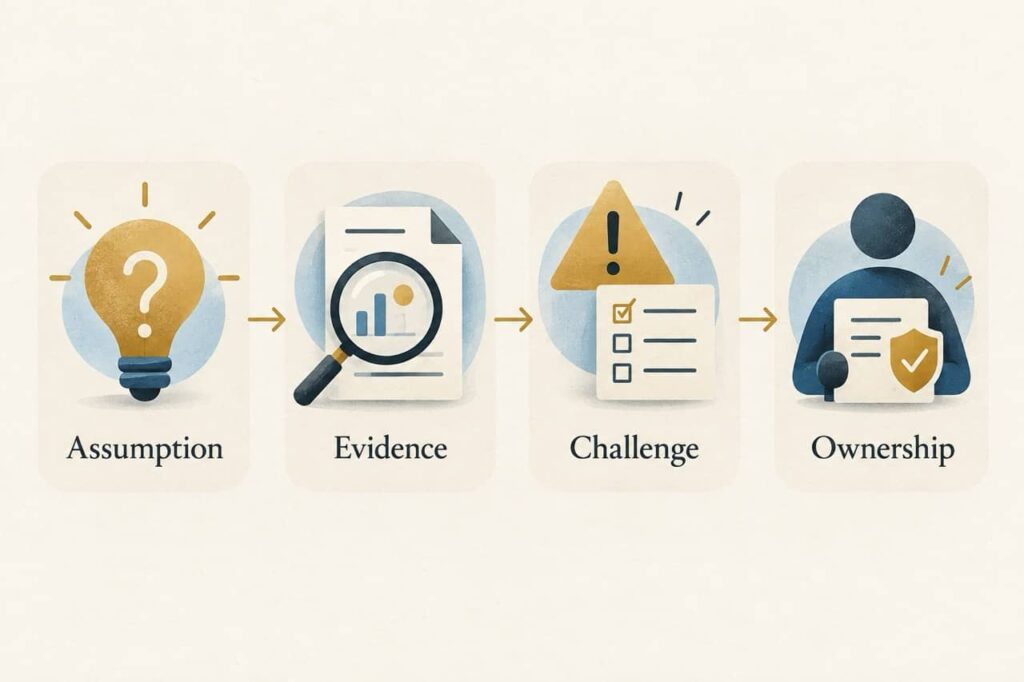
Four questions worth asking
The next time you use AI to create something for your business, whether it’s a website page, marketing plan, SEO strategy, new feature, or even an entire website, try asking four questions before you publish it.
What am I assuming?
Maybe you’re assuming customers care about a particular service. Maybe you’re assuming they understand an industry term. Maybe you’re assuming a feature would make their experience easier.
Write the assumption down.
What evidence do I have?
Did customers actually tell you this? Do your analytics support it? Does your search data show it? Have you seen the problem happen?
Or did an AI assistant simply produce a convincing explanation?
What might be wrong?
This may be the most valuable question of all.
Instead of asking AI to confirm an idea, ask it to challenge the idea. Look for the information that could prove you wrong.
Who understands and owns the result?
Someone should be able to explain what was created, why it exists, how it works, and what happens when something needs to change.
That matters whether AI created 5 percent of it or 95 percent of it.
Think critically
More than a decade ago, Lean Startup Machine taught me to treat an idea as a hypothesis rather than an answer.
AI hasn’t made that lesson obsolete.
It has made it more important.
We can now move from an idea to something that looks remarkably finished in hours instead of weeks or months.
That’s powerful.
It also means we need to become better at recognizing the difference between something that looks complete and something we actually understand.
Use the tools. Experiment. Build things. Be curious.
But most of all:
Think critically.