Tag: Local Search

  • Your Google Business Profile: A Practical Guide for Local Businesses

    Your Google Business Profile: A Practical Guide for Local Businesses

    If someone searches for your type of business in Bloomington right now, the first thing they’ll likely see isn’t your website. It’s your Google Business Profile: the panel that appears in Google Maps and in the results sidebar with your name, hours, photos, reviews, and a button to call or get directions.

    That listing is often making a first impression before anyone ever clicks through to your site. And yet, for many local businesses, it’s either incomplete, out of date, or simply never been given much attention.

    This guide is for the business owner who wants to understand what their Google Business Profile actually does, what to do with it, and how to keep it working for them over time, without a lot of jargon or confusion.

    What a Google Business Profile Actually Is

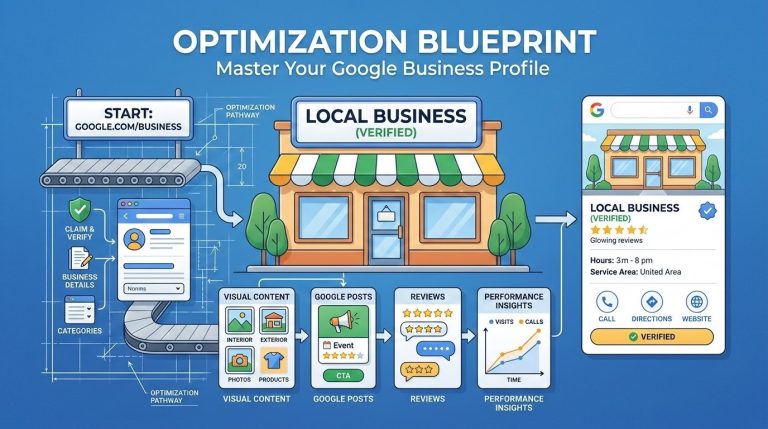
    Google Business Profile (GBP) is a free tool that lets you control how your business appears in Google Search and Google Maps. When you claim and manage your profile, you’re telling Google and the people searching who you are, where you are, when you’re open, and what you do.

    It’s not a social media account, and it’s not a replacement for a website. Think of it as your public information card on Google’s system. Google decides how prominently to display it, but you control what’s on it.

    For businesses that depend on local customers, such as a contractor in Ellettsville, a restaurant on the square, or a nonprofit serving Monroe County, this profile is one of the highest-value tools you have. It’s free, it’s visible, and it directly affects whether people find you when they’re actively looking for what you offer.

    Claiming and Verifying Your Profile

    Before you can manage your profile, you need to claim it. In many cases, Google has already created a basic listing for your business based on information it’s found elsewhere. That listing exists whether you’ve touched it or not.

    How to claim it:

    1. Go to google.com/business and sign in with a Google account you control
    2. Search for your business name and address
    3. If a listing exists, request ownership and Google will guide you through verification
    4. If no listing exists, you can create one from scratch

    Verification is the step Google uses to confirm you’re legitimately associated with the business. The most common method is a postcard mailed to your business address with a code. Some businesses qualify for phone, email, or video verification instead. Service-area businesses (those without a fixed storefront) can still claim a profile but should set a service area rather than displaying a home address.

    One note: The verification process can take a few days to a couple of weeks. Don’t let that stop you from getting started.

    The Profile Sections That Matter Most

    Once you’re in, there’s a lot to fill out. Not all of it carries equal weight. Here’s where to focus first.

    Business Name, Address, and Phone

    These need to be accurate and consistent with how your business appears everywhere else online: on your website, in local directories, on social media. Even small differences (abbreviating “Street” vs. spelling it out, or using a local number vs. an 800 number) can create confusion for Google’s systems. Consistency matters more than most people realize.

    Business Categories

    This is one of the most consequential fields on your profile. Your primary category tells Google what type of business you are, and it directly influences which searches you’re eligible to appear in.

    Choose the most specific, accurate primary category available, not the broadest one. If you’re a plumber, choose “Plumber,” not “Contractor.” If you’re a Mexican restaurant, choose “Mexican Restaurant,” not “Restaurant.”

    You can add secondary categories for other services you offer. Be selective. Adding categories that don’t fit your business can actually hurt your relevance for the searches that matter most.

    Business Description

    You have 750 characters to describe your business. Use them to explain what you do, who you serve, and what makes your business worth contacting. Write it for a person, not a search engine. Don’t try to stuff keywords into every sentence; that approach is obvious and unhelpful.

    A good description is specific, honest, and grounded. Mention the community you serve if that’s relevant. Mention how long you’ve been in business if that builds credibility. Skip the superlatives.

    Hours

    Keep these accurate, including holiday hours. When your hours are wrong, people show up to a closed door. That’s a frustrating experience that reflects on your business, not on Google.

    Most GBP accounts let you set special hours for holidays in advance. This is worth doing. It takes a few minutes and prevents a lot of confusion.

    Services and Products

    Many businesses skip this section entirely. That’s a missed opportunity. Google uses your services list to match you with relevant searches, and some of these entries show up directly on your profile card.

    List the specific services or products you offer. You can add descriptions and prices. Don’t overthink it; just be accurate and reasonably complete.

    Attributes

    Attributes are additional facts about your business: accessible entrance, LGBTQ+-friendly, women-owned, outdoor seating, accepts credit cards, and so on. These appear on your profile and can filter search results for people with specific needs.

    Go through the attributes available for your business category and check the ones that apply. Some of these matter more than you’d expect to specific segments of customers.

    Photos and Visual Content

    Profiles with photos consistently outperform those without. This isn’t a surprise. People want to see where they’re going, who they’re working with, and what to expect.

    What to add:

    • A cover photo that represents your business clearly (exterior, team, or work environment)
    • A logo
    • Interior and exterior shots if you have a physical location
    • Photos of your work, products, or team
    • Real photos, not stock images; authenticity matters here

    You don’t need a professional shoot to get started. Decent photos taken on a modern phone are fine. What matters more than production quality is accuracy and relevance.

    A practical note: Google allows anyone, including customers, to add photos to your profile. You can’t remove most of these. The best way to manage your visual presence is to upload enough good photos of your own that the profile accurately represents your business.

    Update your photos periodically. A profile with photos from 2018 gives people the impression that nothing has changed, or that no one is paying attention.

    Google Posts

    Most business owners have never heard of Google Posts, and most who have don’t use them. That’s a missed opportunity, because they’re a straightforward way to add current, relevant content directly to your profile.

    A Google Post is a short update (text plus an optional photo and call-to-action button) that appears on your profile in search results. Posts expire after seven days or when an event ends, so they’re most useful for things like:

    • Current promotions or sales
    • Upcoming events
    • New products or services
    • Seasonal announcements
    • Anything time-sensitive you want customers to know about

    They don’t dramatically change your rankings, but they do give people more reason to engage with your profile, and they signal to Google that your profile is actively maintained.

    Posting once a week or every two weeks is plenty for most businesses.

    The Q&A Section

    The Q&A section on your profile allows anyone to ask a question about your business, and anyone to answer it. That includes your customers, but it also includes strangers who may or may not give accurate information.

    This is one of the most overlooked parts of a Google Business Profile, and it’s also one of the most practical.

    What you should do:

    • Periodically check your Q&A section for new questions
    • Answer any that have come in, especially if the existing answer is wrong or missing
    • Seed the section yourself by asking and answering common questions proactively (“Do you offer free estimates?” “Is parking available?” “Do you work with insurance?”)

    By populating Q&A with accurate answers to questions you know customers ask, you reduce confusion and help people make faster decisions. It also fills the profile with useful, relevant content.

    Reviews: The Part Most Businesses Find Uncomfortable

    Reviews are one of the strongest signals in local search. A business with many recent, relevant reviews tends to rank better than one with few or none, all else being equal. More importantly, reviews are often what tips the decision for a potential customer reading your profile.

    Getting Reviews

    The most effective thing you can do is simply ask, directly, after a good experience. “Would you be willing to leave us a Google review? It really helps.” Many satisfied customers never think to leave one unless they’re reminded.

    You can make this easier by sharing a direct link to your review section. Google provides one in your profile dashboard. Include it in follow-up emails, on a business card, or in a text to a customer who just expressed satisfaction.

    What you should not do: offer incentives for reviews, ask only customers you know will say something positive, or use any service that generates fake reviews. These practices violate Google’s policies and, more fundamentally, they undermine the trust that makes reviews valuable in the first place.

    Responding to Reviews

    Respond to every review, positive and negative. For positive reviews, a brief, specific thank-you is enough. Don’t use a copied template for every response; it reads as indifferent.

    For negative reviews, the goal is not to win an argument. It’s to respond in a way that demonstrates to future customers that you take concerns seriously and handle them professionally. Keep your response calm, brief, and constructive. Acknowledge the concern, offer to make it right if appropriate, and move on.
    For a more detailed look at this, see my post on responding to negative reviews on Google Business.

    What Affects Your Ranking in Local Search

    Google uses a combination of signals to decide which businesses appear in the “local pack,” the map and three-listing block that appears near the top of local search results. The three primary factors are:

    Relevance: Does your profile match what the person searched for? This is why category selection and service descriptions matter.

    Distance: How far is your business from the person searching, or from the location they specified?

    Prominence: How well-known and trusted is your business based on available information? This includes review quantity and quality, citation consistency across the web, links to your website, and the completeness of your profile. For a closer look at citation work, see my local search marketing service.
    You can’t do much about distance. But relevance and prominence are both things you can work on systematically over time. I cover all three as a connected whole through my Local SEO service.

    GBP and AI-Powered Search

    Google’s AI-generated summaries, the kind that now appear at the top of many search results, pull from publicly available sources, and your Google Business Profile is one of them. A complete, accurate, regularly updated profile gives AI systems more reliable information to work with when describing your business to someone who’s searching.

    This is the same principle behind other emerging practices like llms.txt files: the more clearly and accurately you represent your business in structured, public sources, the better positioned you are as search continues to evolve.

    Ongoing Maintenance: What “Keeping It Current” Actually Means

    A Google Business Profile isn’t something you set up once and forget. It needs periodic attention. Here’s a realistic maintenance checklist:

    TaskFrequency
    Check for new Q&A questionsMonthly
    Respond to new reviewsWithin a week of posting
    Update hours for upcoming holidaysBefore each holiday
    Add a Google PostEvery 1-2 weeks
    Upload new photosEvery 1-2 months
    Review your categories and servicesEvery 6 months
    Check for unauthorized editsMonthly

    That last item deserves a note: Google allows users to suggest edits to any profile, and sometimes those suggestions are accepted automatically. It’s worth logging in regularly to confirm your information hasn’t been changed without your knowledge.

    When to Get Help

    Many business owners can manage their Google Business Profile on their own once they understand what’s involved. The setup and optimization work is more effort upfront; ongoing maintenance is lighter.

    That said, some situations benefit from outside help:

    • You’ve never claimed your profile and aren’t sure where to start
    • Your profile has inaccurate information you can’t seem to correct
    • You’ve been suspended or face a verification issue
    • You want your profile integrated into a broader local SEO strategy
    • You simply don’t have time to keep up with it consistently

    I help Bloomington-area businesses claim, set up, optimize, and maintain their Google Business Profiles as part of my Local SEO service. If you’re not sure where your profile stands, a conversation is a reasonable first step.

    Summary: What to Focus On

    If you take nothing else from this guide, here’s the short version:

    1. Claim and verify your profile if you haven’t already
    2. Complete every major section: name, categories, description, hours, services, attributes
    3. Add real photos and keep them updated
    4. Ask for reviews from satisfied customers, and respond to all of them
    5. Check in regularly, at least once a month, to catch anything that needs attention

    Your Google Business Profile won’t replace a well-built website or a consistent long-term marketing effort. But for local visibility, it’s one of the most direct tools you have, and it costs nothing but time.


    David Martin Design is based in Bloomington, Indiana and works with small businesses, nonprofits, and community organizations on web design, local SEO, and digital marketing. Learn more about our work