A 14-year local publication moves to a modern platform without losing its archive or its footing.
The Client
Bloom Magazine has published six times a year in Bloomington, Indiana since 2006. It covers local food, arts, community, health, business, and the people who make Monroe County worth knowing. Over nearly two decades it built a digital archive of more than 3,000 articles - content that still draws readers from search, still gets cited, and still represents work that took real effort to produce.
That archive was not something to leave behind.
The Problem
Bloom's website was running on a legacy page builder theme with years of accumulated complexity. Managing it required navigating a proprietary shortcode system that had grown harder to use over time. Simple updates - changing a page, swapping a cover image - took more effort than they should. Hosting costs had increased. And the team responsible for keeping the site current was small: a managing editor, an operations manager, and an associate publisher, none of whom should need a developer to update the Current Issue page six times a year.
The original conversation was about a redesign. The real question was about what platform a team like this could actually maintain.
The Approach
After reviewing the existing site, the recommendation was to start fresh - a clean WordPress installation rather than another layer of patches on an aging foundation.
This was the harder path in the short term. It meant building every template from scratch and migrating a substantial archive. But continuing to build on the existing page builder would have left the team dependent on tooling moving away from where WordPress was heading, and would have made every future update more complicated than necessary.
The fresh start also made it possible to move hosting to a local Indiana provider at the same monthly cost - a practical improvement that kept the relationship with a Bloomington-based business and gave more direct control over the server environment.
Read more about how we approach projects like this →
The Work
3,067
Published posts migrated
300K+
Individual files transferred
20 GB
Original photography preserved
14 yrs
Of archives kept intact
Web design and WordPress development
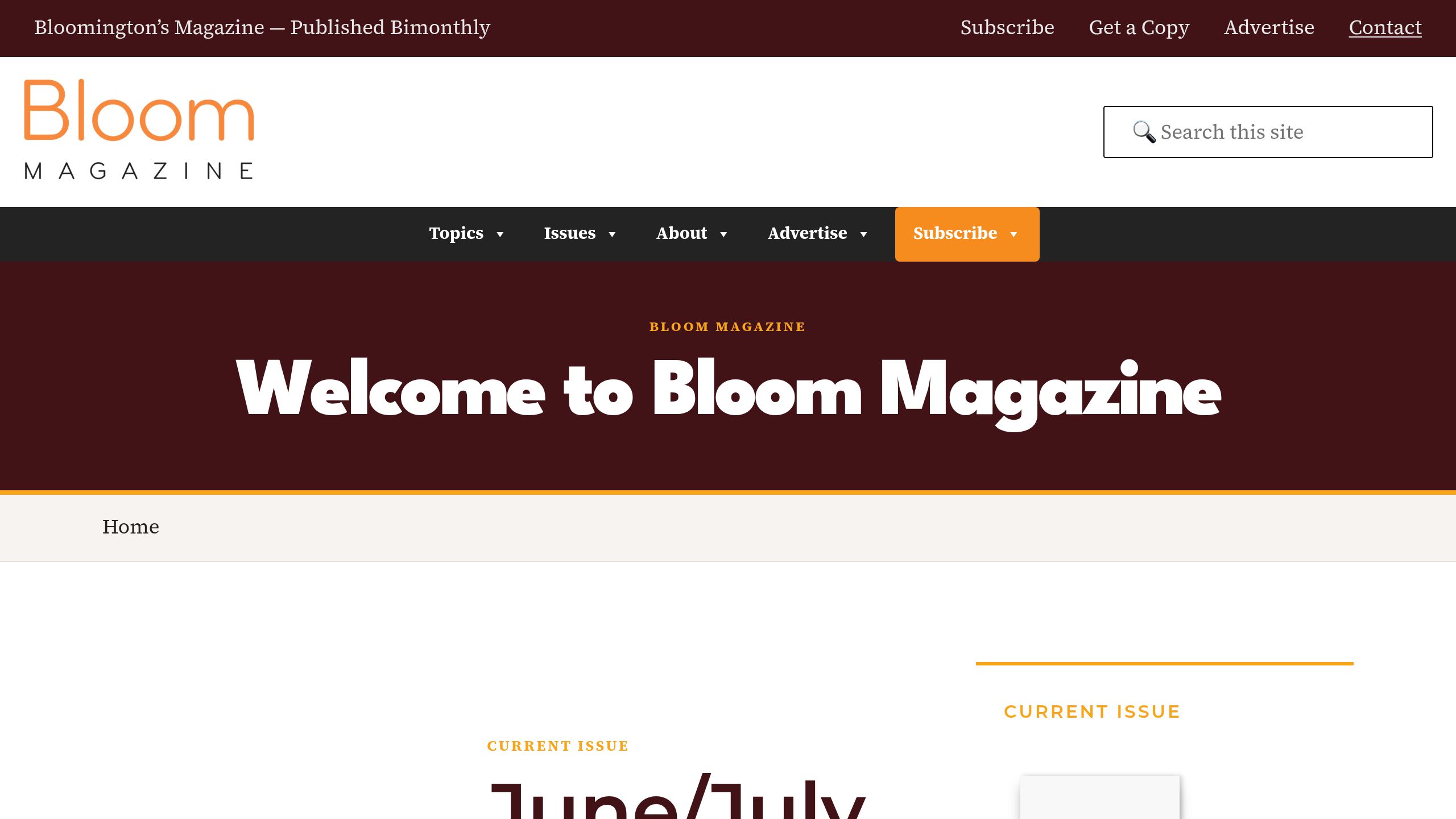
The new site is built on WordPress Twenty Twenty-Five using Full Site Editing and Gutenberg blocks. Every template - single posts, category archives, the current issue viewer, subscribe, distribution locations, search results, and 404 - was designed from scratch using a consistent design system: Bloom's brand colors, department color palette, and typography applied globally through the styles panel. The header, footer, and page templates are all editable through the Site Editor without developer access. Updating the Current Issue page for a new issue means changing four things - the issue label, cover image, flipbook ID, and table of contents. The structure handles the rest.
Content migration
14 years of editorial content moved to the new server. 3,067 published posts going back to 2012. 300,000+ individual files. 20 GB of original photography. 39 digital magazine flipbooks preserved and reintegrated. Broken URLs from the old structure repaired through systematic redirect mapping.
The media library required particular care. Years of theme changes had left behind thousands of redundant thumbnail files. Rather than regenerate them for a theme that no longer existed, we cleared the duplicates and configured the server to serve original images on demand. That single decision reduced the storage footprint from 38 GB to 20 GB.
Hosting and domain management
The domain transferred to a new registrar and nameservers were pointed directly to a locally managed VPS, eliminating a third-party DNS proxy that had been adding $240 per year in unnecessary cost. All Google Workspace mail records were rebuilt in the new DNS zone. Email was uninterrupted throughout the cutover.
The Collaboration
A few weeks after launch, we met at Bloom's office with the full team, including Malcolm Abrams, the owner and editor. Malcolm came in with direct observations: the brand orange needed to dominate, the current issue needed to be the first thing a visitor saw, and the navigation was more complex than it needed to be.
Every observation was correct. Working through the Site Editor together, we simplified the navigation to a clean flyout structure, adjusted color application across templates, and walked the team through editing fonts, menus, and page layouts using the block editor. The changes Malcolm identified made the site clearer and more consistent with how Bloom presents itself in print.
"I really appreciate you doing this. I know how difficult it is."
Malcolm Abrams, Owner & Editor - Bloom Magazine
The Result
The site launched June 6, 2026, after two full days of work over a weekend. The complete archive was intact. Email was uninterrupted. The new design was live. A legacy cloud storage account from the previous hosting arrangement was confirmed safe to cancel, ending an additional recurring charge on top of the $240 per year already saved on DNS.
Post-launch support has been hands-on and responsive. The site is stable and in active use. The team can manage their own content without calling a developer.
✓ 14-year archive intact
✓ Email uninterrupted throughout
✓ Hosting cost matched or reduced
✓ Team manages their own site
✓ $240/yr saved on DNS alone
✓ Local Indiana hosting provider
What This Demonstrates
Bloom Magazine is a good example of the kind of work this studio is built for: a local institution with limited technical resources, a real archive worth preserving, and a team that needs tools they can actually use.
Work like this requires honest scoping, a willingness to recommend the less convenient path when it is the right one, and patience to stay with a project through the complexity that migrations of this scale always produce.