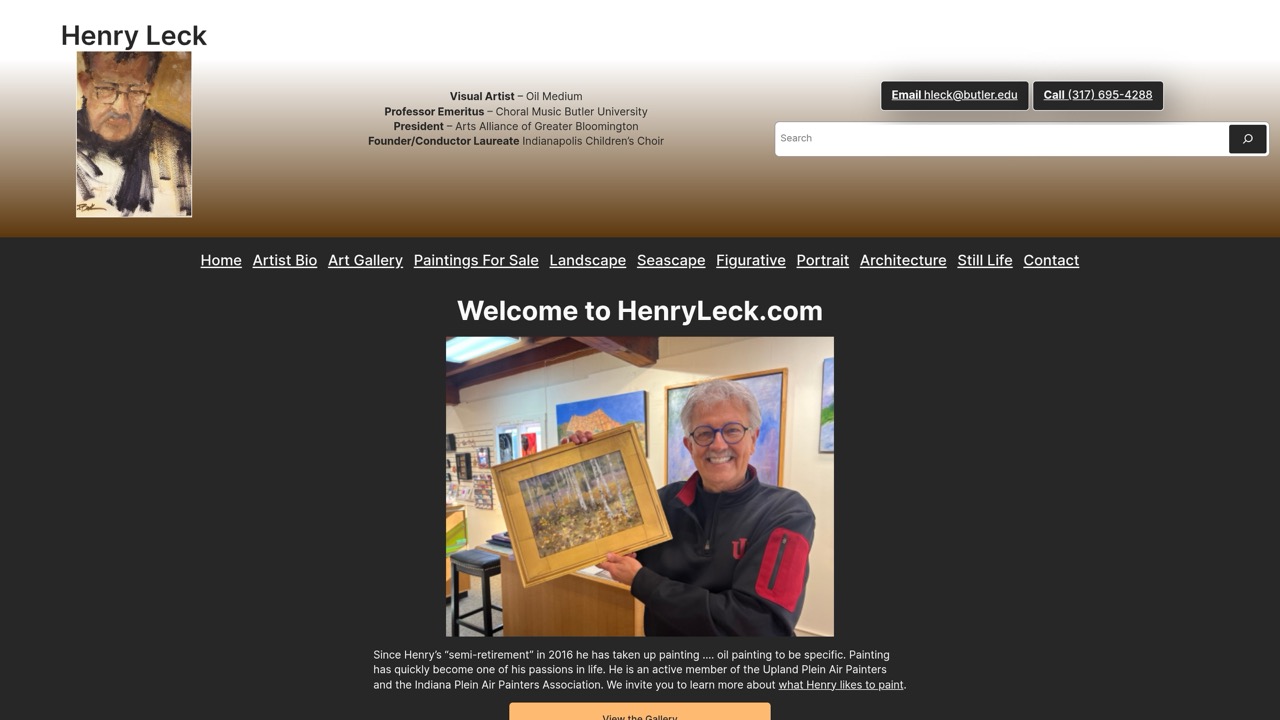
Six Years of Oil Paint and WordPress: How Henry Leck Built a Working Artist's Website
When Henry Leck came to me in 2020, he wasn't looking for a business website. He was looking for a place to show his paintings.
That might sound simple. But Henry isn't a simple person. He's Professor Emeritus in Choral Music at Butler University, where he taught for 27 years. He founded the Indianapolis Children's Choir and served as its Conductor Laureate for three decades. He has conducted on stages around the world. And since stepping back from full-time conducting around 2016, he has quietly become a serious oil painter.
The previous website Henry had was a career archive -- clinician, author, educator, conductor. The new one needed to do something different: it needed to show paintings, tell their story, and actually sell them.
We've been working together ever since. This is the story of how that went.
How We Met
Henry and I are both connected to the Arts Alliance of Greater Bloomington, now known as Pillar Arts. That's how he found me. It's a good reminder of why I stay involved with the local arts community -- the relationships you build there are real ones.
Starting During Covid
We began the project in the fall of 2020, which meant figuring out remote collaboration before that was normal for either of us. We held our first meetings on Google Meet, which turned out to work well. We could see each other, share screens, and actually look at the inventory together.
For the underlying structure of the site, we set up a shared Google Drive folder. Henry would upload photos of his paintings and add entries to a Google Sheets inventory spreadsheet I helped him set up. Each painting got a SKU number, dimensions, medium, location, price, and sale status. That spreadsheet became the source of truth for everything -- the website, the record of what sold, what's still available, and where each piece lives.
One of the first decisions we made was to recover his existing domain, henryleck.com, rather than starting with a new one. Henry had registered it previously, and reclaiming it was worth the extra effort: domain age matters for search rankings, and "Henry Leck" is exactly the name people would search for.
What We Built
The site runs on WordPress on my managed hosting server. The setup is intentionally simple.
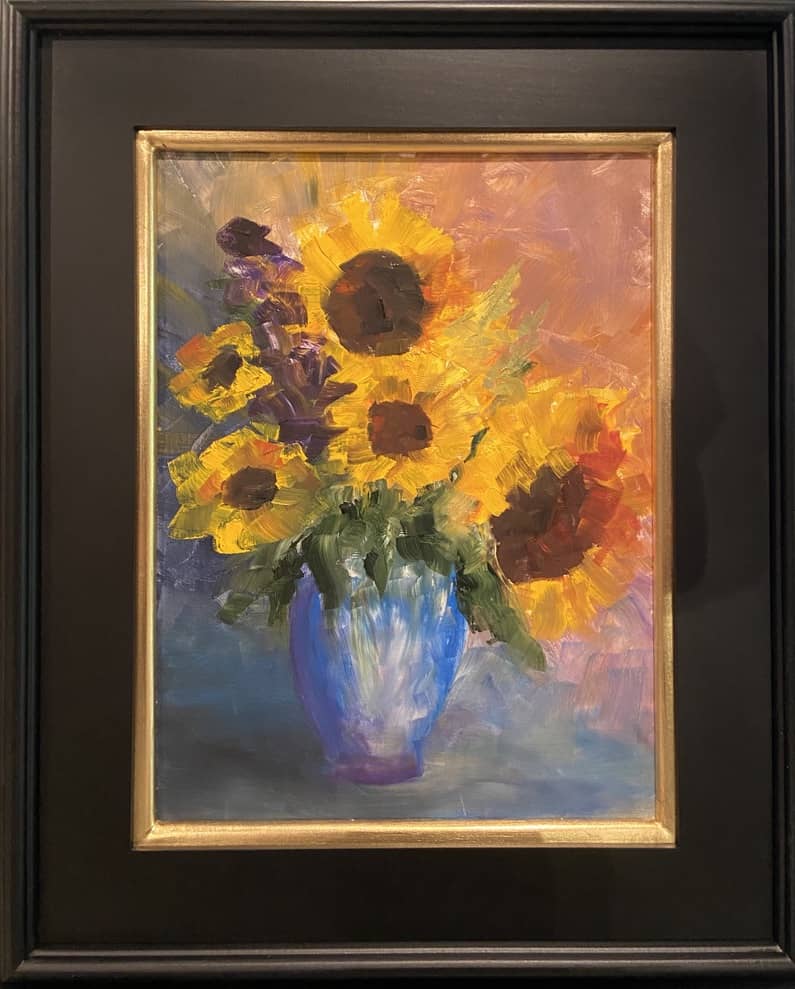
Each painting gets its own WordPress post in the Art category, tagged by subject, medium, and style. When a painting is for sale, it also gets added to a For Sale category, and I create a Stripe payment link and embed a button at the bottom of the post. When it sells, I remove the button, update the post, mark it as sold in the master inventory spreadsheet, and update the category.
No WooCommerce. No plugin-heavy e-commerce layer. Just WordPress posts, thoughtfully organized, with a direct payment link.
Every image gets a keyword-rich filename before it's uploaded -- something like henry-leck-art-386-horizon-oil-landscape.jpg instead of IMG_4821.jpg. That's a small thing that adds up significantly over time, especially for an artist whose name people are already searching for. Each post also gets SEO-optimized alt text, a caption, and a description.
I also set up Google Analytics, Google Search Console, Microsoft Clarity, and Wordfence security from the start. Those aren't exciting features, but they mean the site has a clean security record and I can see exactly how people are finding and navigating Henry's work.
What Six Years of Ongoing Work Actually Looks Like
A site like this isn't a project you finish. It's a practice you maintain.
Henry paints constantly. He's an active member of the Upland Plein Air Painters and the Indiana Plein Air Painters Association. Paintings come in batches -- sometimes a handful, sometimes ten at a time. He might have a show opening this weekend and need new work posted. He might sell three pieces in a month and need them marked off the site.
The workflow we've developed looks like this: Henry photographs a new piece and adds it to the master inventory spreadsheet. He uploads the image to the WordPress media library when he can. I handle the rest -- renaming files, writing the post, generating the Stripe payment link, setting categories and tags, and making sure everything looks right.
More recently, we've brought AI into the metadata process. I use Claude to draft structured descriptions, captions, alt text, and filenames for new batches of paintings, then review and post them. In March 2026, Henry was doing some of this work himself, and noted in an email that Claude had stopped partway through a batch -- "I got all but one on here when Claude refused to continue." That's the kind of honest friction that comes with using any tool, including AI ones.
As of today, there are 296 posts on the site.
The Things That Go Wrong (and How We Handle Them)
I want to be honest here, because this is where most case studies go quiet.
Image file formats. Henry photographs his paintings on his phone or camera, and the files sometimes come in as HEIC or other formats that WordPress won't accept. I handle the conversion.
Stripe notifications. In July 2026, Henry noticed a payout had arrived but had no idea which painting had sold. When I looked into it, the "Successful payments" toggle in Stripe's customer email settings had been switched off -- he wasn't getting sale notifications. I turned it on, identified the painting from the Stripe transaction record, and sent him the details. He replied: "Thanks so much Dave!" A similar situation had come up in August 2024 as well. Finding the source of the problem took a few minutes; fixing it took seconds. That's what a good working relationship makes possible.
Duplicate tags and metadata. Over time, tags accumulate. In June 2026, I did a full cleanup of the post tag library -- removing duplicates, consolidating one-off tags that had never been used again, and tightening the taxonomy. Henry's response after seeing the result: "Super Thanks."
None of these are dramatic. But handled promptly and clearly, they stay small. That's the point.
Is It Working?
Most of Henry's sales still happen in person -- through galleries, shows, and word of mouth. That's true for most artists at his level. But buyers have come from outside his immediate network, people who found a painting on the site and purchased it without ever meeting Henry in person. That's a meaningful shift for an artist who didn't have a dedicated art site six years ago, and it's happening more over time.
What I've Learned from This Project
A few things stand out after six years.
Simple works. We didn't need e-commerce software, a plugin stack, or a complex theme. We needed a clean WordPress install, a disciplined naming convention, and a spreadsheet. The simpler the system, the easier it is to maintain.
The relationship is the product. Henry trusts me to handle things correctly and to tell him when something needs attention. I trust him to give me accurate information about what sold, what's new, and what needs to change. That trust has been built up slowly, one small exchange at a time.
An ongoing engagement looks different than a launch. Most web design case studies are about the build. This one is about what comes after. The launch was November 2020. The more interesting work is everything since then -- the inventory management, the troubleshooting, the small improvements that add up to a site that actually serves a working artist over the long term.
Henry is one of the kindest people I've worked with in more than 20 years of doing this. He appreciates doing things well. That comes through in how he paints, and I try to make sure it comes through in how his website represents him.
About Henry Leck
Henry Leck is a Professor Emeritus in Choral Music at Butler University, Founder and Conductor Laureate of the Indianapolis Children's Choir, and an active oil painter based in Bloomington, Indiana. You can see his work at henryleck.com.
David Martin Design has provided web design, hosting, and digital marketing services to clients in Bloomington, Indiana and beyond since 2004. If you're an artist or creative professional looking for a website that works the way you work, let's talk.